If you observe life carefully, you will realize that it does not go in a straight line. Instead, it has phases.
There are phases when life goes smoothly, and opportunities come at the right time. There are phases when everything slows down, and you have to wait for things to happen. There are phases when you are left wondering why life has to go this way.
Questions like this often come up during astrology sessions:
- Why do certain things happen at certain times in life?
- Why do certain phases feel like the right time to do things, while others feel like the time to wait?
- Are there any factors in astrology that can explain this phenomenon?
In Vedic astrology, the concept of Mahadasha and Antardasha has been used to understand the phenomenon of phases in life.
While the birth chart explains the overall pattern of life, the Dasha system has been used by astrologers to understand the phases in life.
In simple terms, the Dasha system has been used to understand when certain things may happen in life.
In this article, we will try to understand what exactly Mahadasha and Antardasha are, how this system has been used, and why it is considered to be one of the most important systems in astrology.
Quick Summary
For those who are new to astrology, the concept can be explained very simply:
- Mahadasha – The main planetary period that affects the phases in life.
- Antardasha – A smaller period that operates during the main period.
- Each planet influences life for a specific number of years.
- Astrologers use the analysis of planetary periods along with the birth chart to understand events and changes that occur in life.
- You may think of Mahadasha as the chapter of a book, while Antardasha is the section within that chapter.
Did You Know?
The total period of planetary cycles is 120 years, according to the classical Vimshottari Dasha system.This entire period is distributed among the nine planetary influences recognized in Vedic astrology. The starting point of this cycle depends on the position of the Moon at the time of birth.This is one of the reasons why planetary periods play such an important role in astrology. Even people born in the same year may experience different planetary phases at similar stages of life.
A Simple Example of How Dashas Work
To better understand the idea behind dashas, let’s take a simple example.
Suppose two individuals want to grow in their careers.
One person may be going through the Jupiter Mahadasha, which is generally associated with growth, opportunities, and learning. During this period, they may receive opportunities for higher education or guidance from mentors who help them move forward.
Another person may be going through the Saturn Mahadasha, which is often associated with responsibility and discipline. During this time, they may face challenges that help them grow, although the progress may feel slow.
Both individuals may eventually achieve their goals, but the experience of the journey may be different.This is why astrologers analyze planetary periods together with the birth chart to understand life patterns.
What Is Mahadasha in Vedic Astrology?
Mahadasha, as the name suggests, is a significant planetary period whose influence affects a particular phase of life.
Each planet governs a specific number of years, and during that time the influence of the planet becomes more prominent.
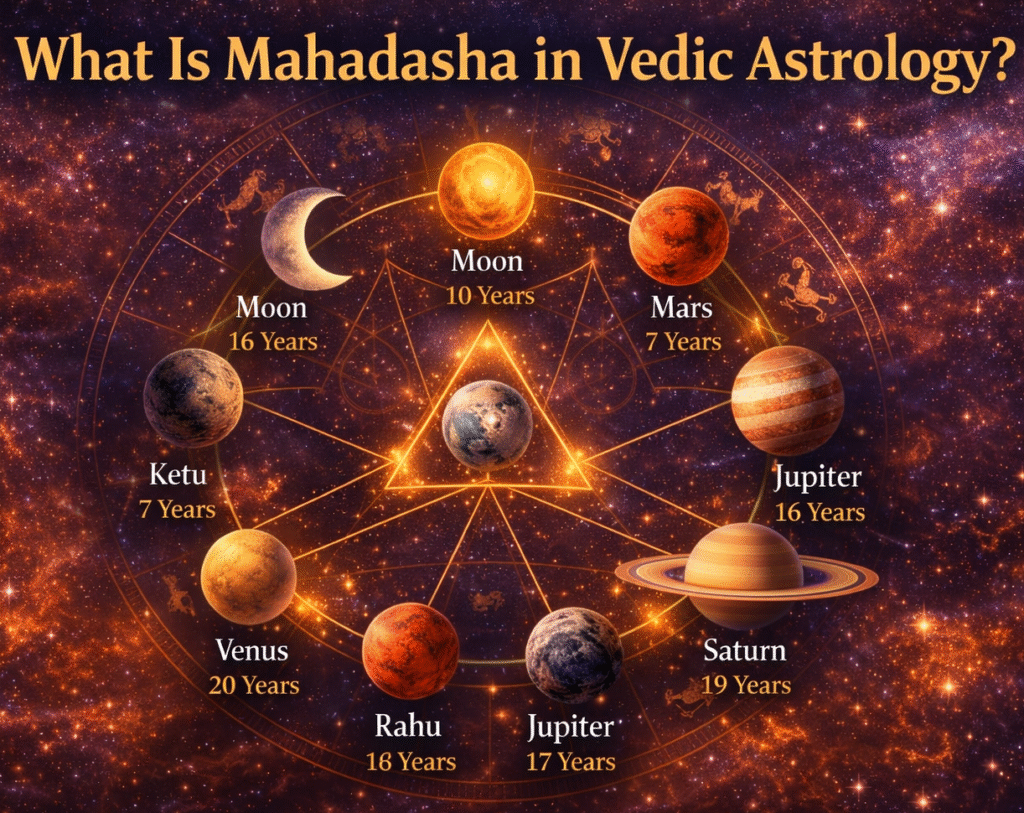
According to the Vimshottari Dasha system, the approximate duration of each Mahadasha is as follows:
- Sun Mahadasha – 6 years
- Moon Mahadasha – 10 years
- Mars Mahadasha – 7 years
- Rahu Mahadasha – 18 years
- Jupiter Mahadasha – 16 years
- Saturn Mahadasha – 19 years
- Mercury Mahadasha – 17 years
- Ketu Mahadasha – 7 years
- Venus Mahadasha – 20 years
Each Mahadasha is associated with themes connected to that planet.
For example:
- Jupiter Mahadasha – Education, growth, and guidance
- Saturn Mahadasha – Responsibilities, discipline, and life lessons
However, the actual influence of Mahadasha depends on the position of the planet in the birth chart.
Also Read: What Is Kundli Analysis?
What Is Antardasha?
Antardasha is a sub-period that operates within a Mahadasha.
While Mahadasha represents the major phase of life, Antardasha represents the smaller period that shapes how that phase unfolds.
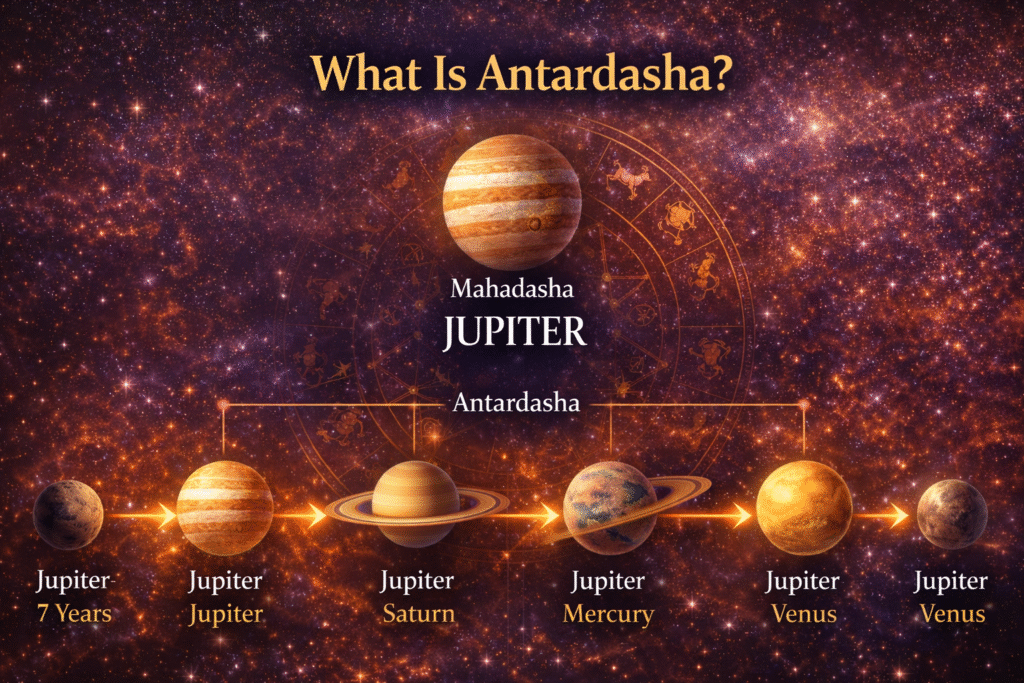
For example, during Jupiter Mahadasha, different Antardashas may occur such as:
- Jupiter–Jupiter
- Jupiter–Saturn
- Jupiter–Mercury
- Jupiter–Venus
Each of these combinations adds another layer to interpretation.
For instance:
- Jupiter–Mercury may highlight learning, communication, or professional development.
- Jupiter–Saturn may emphasize responsibility and structured progress.
Because of this layered structure, astrologers usually study Mahadasha, Antardasha, and planetary placements together.
How the Vimshottari Dasha System Works
The Vimshottari Dasha system is one of the most widely used systems for interpreting planetary periods in Vedic astrology.
It is based on a cycle of 120 years, which is shared among the nine planets.
The sequence of planetary periods is:
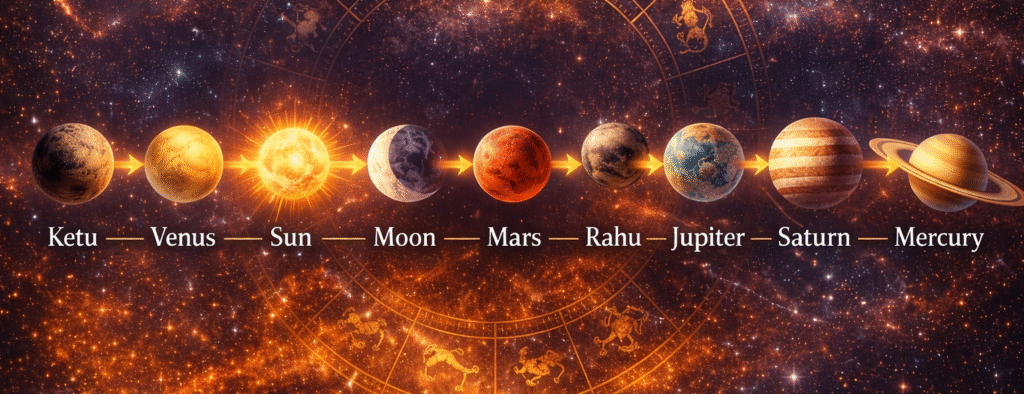
Ketu → Venus → Sun → Moon → Mars → Rahu → Jupiter → Saturn → Mercury
The starting point of this cycle depends on the position of the Moon in the birth chart.This is why two individuals with similar birth charts may still experience different life phases at different times.
Why Dashas Are Important in Astrology
In many cases, astrologers first study the birth chart and then examine the current Mahadasha and Antardasha.
This helps them understand the timing of important developments in life.
Dashas may provide insight into periods associated with:
- career growth
- relationships
- financial opportunities
- personal transformation
- spiritual experiences
However, dashas are usually interpreted together with planetary transits and the strength of planets in the birth chart.
The Role of the Birth Chart in Dasha Interpretation
The effect of a Mahadasha may differ for different individuals.
The outcome depends on several factors, including:
- the sign and house where the planet is placed
- planetary aspects
- the strength or weakness of the planet
- the influence of other planets in the chart
For example, Saturn Mahadasha may feel very different for someone whose Saturn is strong compared to someone whose Saturn is weak or afflicted.
Because of this, astrologers always interpret dashas within the context of the entire birth chart.
(Internal link suggestion: The 9 Planets in Vedic Astrology)
Remedies During Challenging Dashas
In traditional Vedic astrology, astrologers sometimes suggest remedies to balance planetary influences, especially during challenging periods.
These remedies may include:
- chanting Vedic mantras
- charity or donations
- fasting
- wearing recommended gemstones
The purpose of these remedies is to harmonise planetary energies and support positive outcomes.
Conclusion
The concepts of Mahadasha and Antardasha form one of the foundations of predictive astrology in the Vedic tradition.
While the birth chart reveals the overall structure of life patterns, dashas help astrologers understand when certain planetary influences become active.
By studying planetary periods alongside the birth chart, astrologers attempt to interpret phases of growth, challenge, and transformation that appear throughout life.