The Sacred Heart of Divine Love, Compassion & Emotional Healing
Introduction
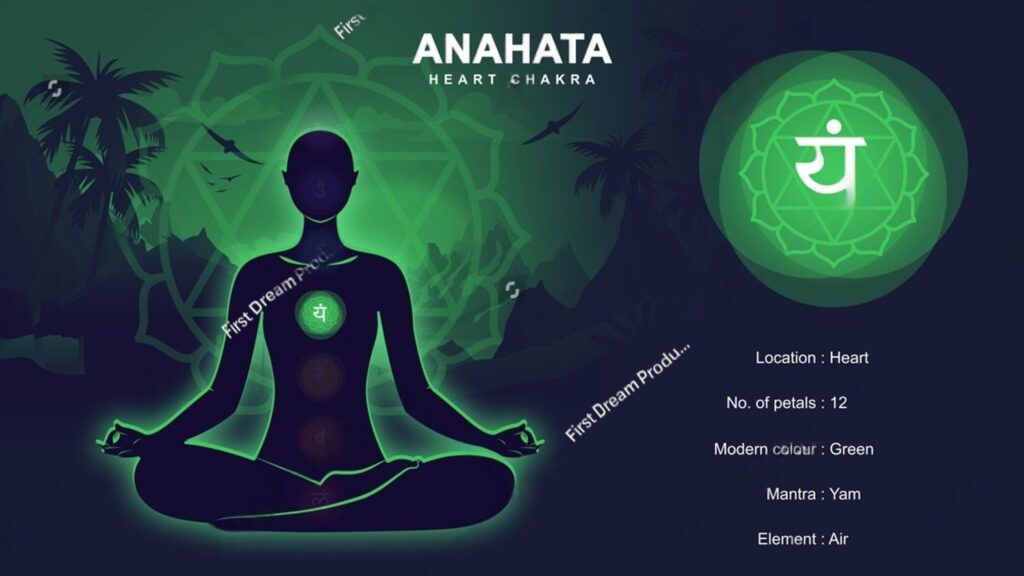
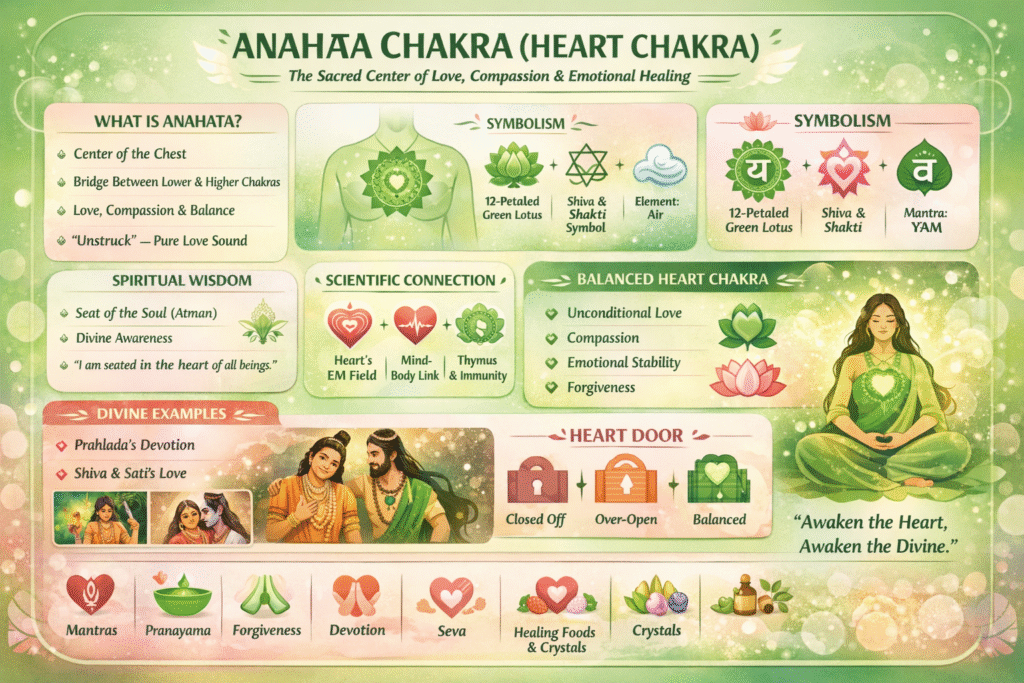
In the subtle yogic system of chakras, the Anahata Chakra, known as the Heart Chakra, is the sacred bridge between the lower earthly chakras and the higher spiritual chakras. It is the meeting point of body and soul. Located at the center of the chest, Anahata governs love, compassion, forgiveness, devotion, and emotional balance.
In Sanskrit, Anahata means “unstruck” or “unbeaten.” It refers to the eternal sound that arises without two objects striking each other — the cosmic vibration of pure love. The heart is not just a physical organ — it is the seat of consciousness (Hridaya), where the Divine resides.
“The heart speaks in a language that the mind cannot translate.”
Symbolism of Anahata Chakra
The Anahata Chakra is represented by:
- A 12-petalled green lotus
- A hexagram (two intersecting triangles) symbolizing union of Shiva (consciousness) and Shakti (energy)
- Element: Air (Vayu Tattva) The air element represents expansion, openness, and connection — just like love.
- Bija Mantra: Yam
“Love is like air — invisible, yet essential for life.”
Scriptural References
While chakras are elaborated in Tantric texts like the Shat Chakra Nirupana, the heart’s spiritual importance appears in multiple Vedic and Puranic scriptures.
The Chandogya Upanishad describes the heart as the abode of the Self (Atman):
This “lotus in the heart” refers directly to Anahata — the spiritual chamber where divine consciousness resides.
Similarly, the Katha Upanishad speaks of the Self seated in the heart of all beings.
In the Bhagavad Gita, Lord Krishna declares:
“I am seated in the heart of all beings.”
This verse reveals that divine awareness is accessed through the heart center — not merely through intellect.
Prahlada’s Devotion
The story of Prahlada in the Bhagavata Purana beautifully illustrates Anahata energy.
Despite torture from his father Hiranyakashipu, Prahlada remained anchored in love and devotion for Lord Vishnu. His unwavering compassion and fearlessness were manifestations of a fully awakened heart chakra. Prahlada did not respond with hatred — he responded with faith.
“The awakened heart does not retaliate; it radiates.”
Shiva & Sati – The Power of Pure Love
The divine love between Shiva and Sati represents unconditional union. When Sati immolated herself due to humiliation, Shiva’s grief shook the universe — symbolizing the immense emotional power of the heart center. Love in its highest form is transformative and cosmic.
Scientific Significance of the Heart Chakra
Ancient yogis intuitively understood what modern science now confirms:
the heart is far more than a pump.
The Heart’s Electromagnetic Field
Scientific research shows that the heart generates an electromagnetic field stronger than that of the brain. This field extends several feet beyond the body. Emotions like love, gratitude, and compassion create coherent heart rhythms, while anger and stress create chaotic patterns.
Vagus Nerve & Emotional Regulation
The heart is closely linked to the vagus nerve, which regulates:
- emotional response
- stress levels
- breathing
- social bonding
Thymus Gland & Immunity
Anahata is associated with the thymus gland, which plays a key role in immune function.
People experiencing prolonged emotional hurt often show weakened immunity — illustrating the mind-heart-body connection.
“A wounded heart does not just feel pain — it weakens vitality.”
Qualities of a Balanced Anahata Chakra
When the heart chakra is balanced, a person experiences:
- unconditional love
- compassion without attachment
- forgiveness
- emotional stability
- healthy boundaries
- empathy without emotional exhaustion
- spiritual devotion
They love deeply — but do not lose themselves.
Signs of an Imbalanced Heart Chakra
Emotional Symptoms
- fear of betrayal
- jealousy
- possessiveness
- inability to trust
- grief that doesn’t heal
- emotional numbness
- over-giving to seek validation
Physical Symptoms
- chest tightness
- asthma or breathing issues
- heart palpitations
- upper back pain
- low immunity
Spiritual Symptoms
- difficulty feeling devotion
- inability to forgive
- disconnect from divine love
The Closed Door
Imagine your heart as a sacred temple with doors.
- If the doors are closed due to past hurt → no love enters.
- If the doors are wide open without boundaries → energy drains out.
- If the doors open consciously → divine love flows naturally.
Anahata teaches balance between vulnerability and strength.
Today’s world struggles with attachment trauma, fear of abandonment, emotional dependency, guarded communication
Most relationship conflicts are not logical — they are heart wounds.
When Anahata is healed:
communication becomes softer, empathy increases, reactions decrease, relationships deepen
“Healing your heart heals your relationships.”
Practices to Balance Anahata Chakra
Mantra Chanting
(Chanting opens subtle vibrations in the chest cavity)
Bija Mantra: Yam
Other powerful mantras:
Om Namah Shivaya
Om Namo Bhagavate Vasudevaya
Pranayama
Since Anahata is linked to air element:
- Anulom Vilom
- Bhramari
- Deep heart breathing
Breath expands emotional space.
Bhakti (Devotion)
Love offered to the Divine purifies personal attachments.
Devotional singing, kirtan and prayer activate heart energy.
Forgiveness Ritual ( MUST DO RITUAL)
Write the name of the person who hurt you with black pen. Offer a silent prayer. Release emotional charge and burn this paper asking universe that you are now forgiving that person and now free and no more attatched or bothered with past hurts given by that person and blow the ashes in universe.
Forgiveness is not approval — it is liberation.
Seva (Selfless Service)
Acts of kindness expand heart frequency.
Even small gestures — feeding animals, helping strangers — awaken Anahata.
Color, Food & Aroma Therapy
- Color: Green & Pink
- Crystals: Rose quartz, green aventurine
- Foods: Leafy greens, tulsi tea, cucumber
- Oils: Rose, jasmine, lavender
Nature heals the heart because it mirrors the air element.
Spiritual Significance
Anahata is the turning point of spiritual evolution.
Lower chakras deal with survival and desire. Higher chakras deal with wisdom and enlightenment.
The heart connects both worlds.
Without love, spirituality becomes dry philosophy. Without grounding, love becomes attachment.
“The path to enlightenment passes through the heart.”
Conclusion
The Anahata Chakra is not merely an energy center — it is the sacred altar of divine presence within you. It governs love, empathy, forgiveness, and spiritual devotion.
Through Vedic wisdom, Puranic devotion, and modern science, we understand that the heart is the true center of human transformation. Balancing the heart chakra does not make you weak — it makes you powerful in the most graceful way.
“To awaken the heart is to awaken the Divine within.”