
When people first begin exploring Vedic astrology, one idea appears again and again—the important role that planets play in shaping the birth chart.
But in astrology, a birth chart is not simply a map showing where the stars and planets were located in the sky. Instead, astrologers often view it as a symbolic guide that helps them understand different influences that may affect a person’s life.
Naturally, this raises an important question for beginners:
What do astrologers really mean when they say that planets influence our lives?
In Vedic astrology, these planetary forces are known as the Navagraha. The Sanskrit word Navagraha literally translates to “nine celestial influencers.”
These nine influences include:
- Sun
- Moon
- Mars
- Mercury
- Jupiter
- Venus
- Saturn
- Rahu
- Ketu
Astrologers study the positions of these planets at the exact moment of birth. Their placement in different houses and zodiac signs is believed to reflect patterns that may appear in different areas of life, including personality, relationships, career, and spiritual growth.
In this article, we will explore the role of the nine planets in Vedic astrology and understand how astrologers interpret their influence while analysing a birth chart.
Read Here: Complete Guide to Vedic Astrology
Quick Summary
If you are new to astrology, here is a simple way to understand the concept of the Navagraha:
- Vedic astrology studies nine planetary influences, known as the Navagraha.
- Each planet represents a particular type of energy or life theme.
- The position of these planets in the birth chart may influence different areas of life.
- Astrologers interpret planetary placements together with houses, zodiac signs, and planetary dashas.
- Most importantly, no planet works alone. The overall meaning of a chart comes from how these planetary influences interact with one another.
What Are the Navagraha in Vedic Astrology?
The concept of the Navagraha comes from ancient Indian cosmology and philosophical traditions.
In classical texts such as the Brihat Parashara Hora Shastra, planets are not described only as physical celestial objects. Instead, they are often seen as symbolic forces connected with karma and different aspects of human life.
Within this framework, the nine planets represent different dimensions of life experience.
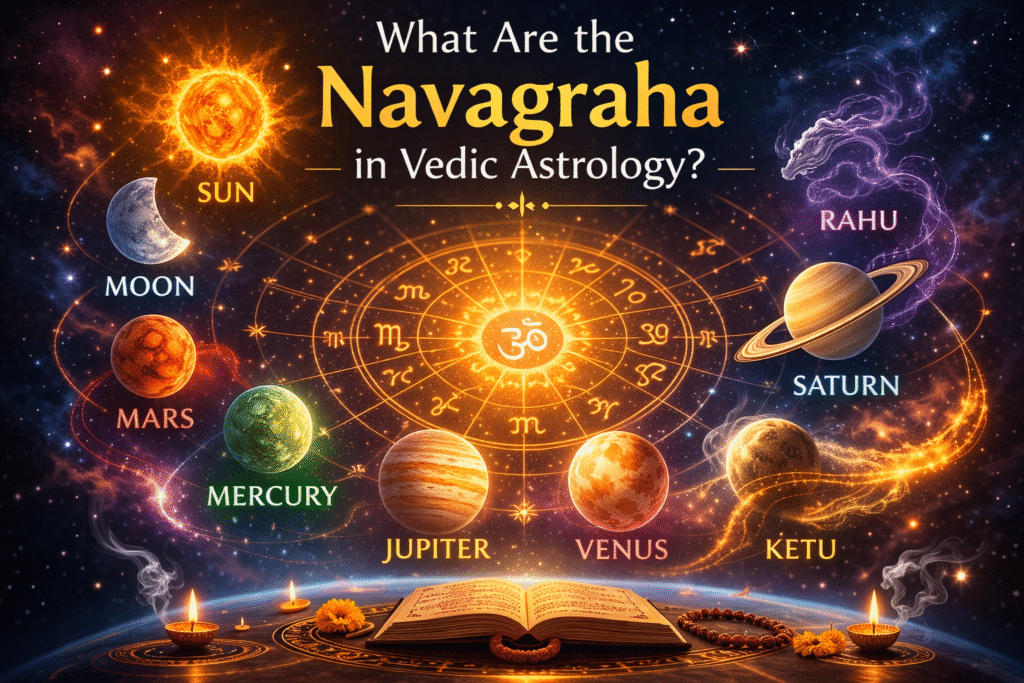
The Navagraha include:
- Sun (Surya)
- Moon (Chandra)
- Mars (Mangal)
- Mercury (Budh)
- Jupiter (Guru)
- Venus (Shukra)
- Saturn (Shani)
- Rahu
- Ketu
The first seven correspond to visible celestial bodies that we can observe in the sky.
Rahu and Ketu, however, are slightly different. They are known as lunar nodes, which are mathematical points where the Moon’s orbit intersects the Earth’s orbital path.Although they are not physical planets, Rahu and Ketu are extremely important in Vedic astrology because they are often associated with karmic patterns, transformation, and major life experiences.
Why Planets Are Important in Kundli Analysis
When astrologers interpret a birth chart, planetary placements are usually among the first elements examined.
However, their influence is rarely interpreted in isolation. Instead, astrologers tend to consider several interacting factors:
- the house where a planet is placed
- the zodiac sign it occupies
- its strength or weakness in the chart
- the aspects it receives from other planets
Through this layered approach, astrologers attempt to understand how planetary energies may manifest in different areas of life.
For readers who are new to astrology, it may help to think of planets as symbolic indicators of psychological tendencies and life themes, rather than fixed determinants of fate.
Read Here: What Is Kundli Analysis
Astrology is rarely about a single planet acting alone. It’s always a conversation.
The Nine Planets: Who’s Actually Pulling the Strings?
In the world of Vedic astrology, we don’t look at planets as just big rocks spinning in a void. We call them Grahas. If you translate that literally, it means “to grasp” or “to seize.” Basically, these celestial bodies “grab” our attention and dictate how we experience reality.
Think of your birth chart like a movie set. The planets aren’t just background actors; they’re the directors, the lighting crew, and sometimes the annoying guy in the back with the megaphone.
The Ego and the Emotions (Sun & Moon)
Let’s start with the Sun (Surya). He’s the undisputed CEO of the chart. If you’ve ever met someone who just radiates authority without even trying, that’s a strong Sun at work. It’s your soul’s spark and your sense of “I am.” But, fair warning: when the Sun gets too loud, it turns into pure ego. It’s the difference between being a leader and just being a loudmouth.
The Sun represents identity, authority, and the core sense of self. In many charts, it highlights where a person seeks recognition and purpose in life.
And interestingly, astrologers often notice something else as well — a strong Sun doesn’t just show confidence. It usually reveals a deep need to express one’s individuality.
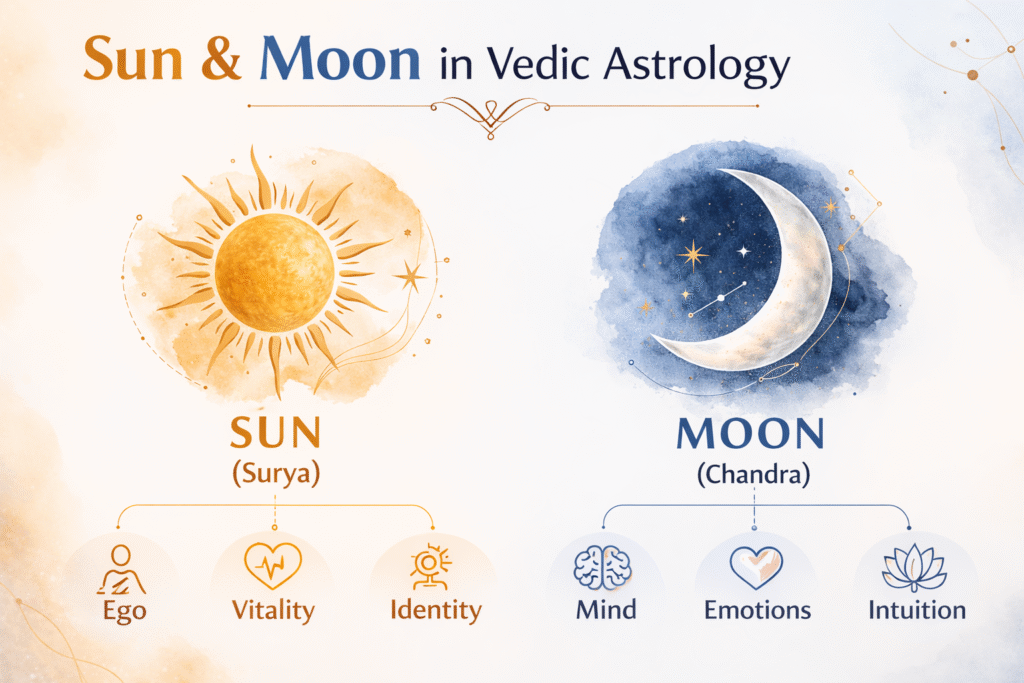
Then you’ve got the Moon (Chandra). If the Sun is your identity, the Moon is your “vibe.” It’s how you process a breakup, how you handle a stressful Monday, and whether you’re a night owl or a morning person. In Vedic astrology, the Moon is actually a bigger deal than the Sun. Why? Because your mind is your reality. If your Moon is happy, a rainy day feels cozy. If it’s stressed, a sunny day feels like a chore.
The Moon represents the mind, emotions, and inner psychological responses. Because of this, many astrologers consider the Moon extremely important when analysing a birth chart.
In fact, experienced astrologers often say that understanding the Moon in a chart is the first step to understanding the person behind the chart.
The Hustlers: Mars and Mercury
Mars (Mangal) is essentially your inner soldier. It’s the drive that gets you to the gym when you’d rather stay in bed. When it’s working well, you’re courageous and focused. When it’s messy? You’re picking fights in the YouTube comments section. It’s raw, red-blooded energy that needs a job to do, or it’ll start causing trouble.
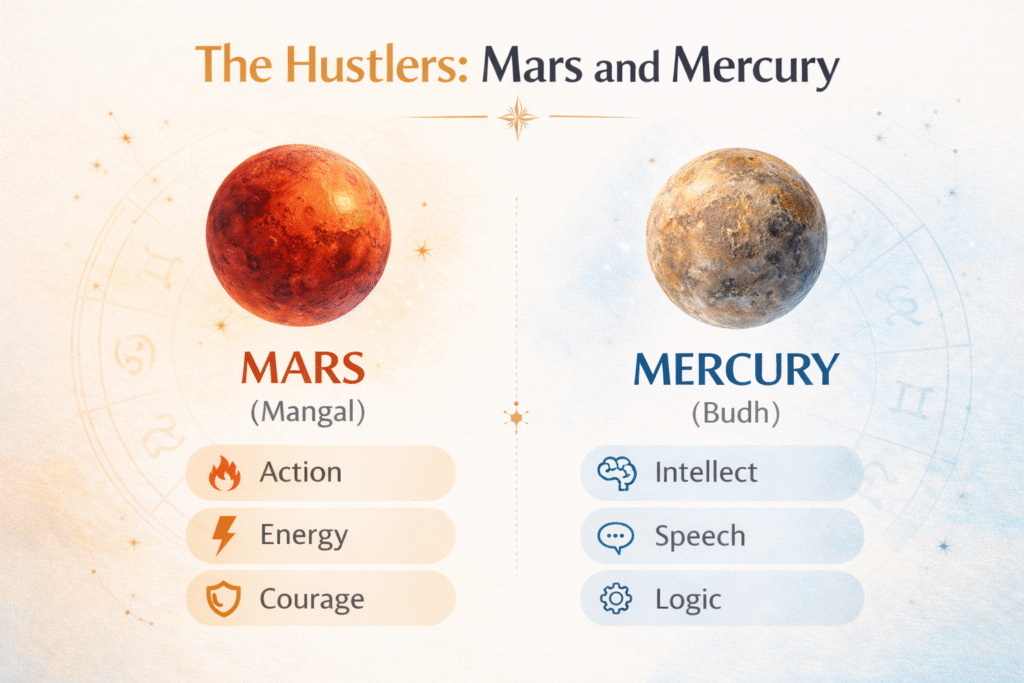
Mercury (Budh) is the guy who knows a guy. He’s the planet of communication, commerce, and “the hustle.” If you’re quick with a joke or good at spreadsheets, thank Mercury. He’s the bridge between your thoughts and the rest of the world. He’s not interested in deep, heavy philosophy—he just wants to know how things work and how to sell them.
The “Life Lessons” Crew: Jupiter, Venus, and Saturn
Jupiter (Guru) is the big, friendly mentor we all want in our corner. He’s about expansion, luck, and the “Big Picture.” When Jupiter is active, things just seem to go your way. It’s the energy of growth and wisdom. He’s the one telling you to stay optimistic and keep learning.
On the flip side, you have Venus (Shukra). This isn’t just about “love” in a Hallmark card kind of way. It’s about what you value. It’s your taste in clothes, your love for a good meal, and how you connect with others. Venus makes life worth living, but she can also make you a bit lazy if you spend all your time chasing comforts.
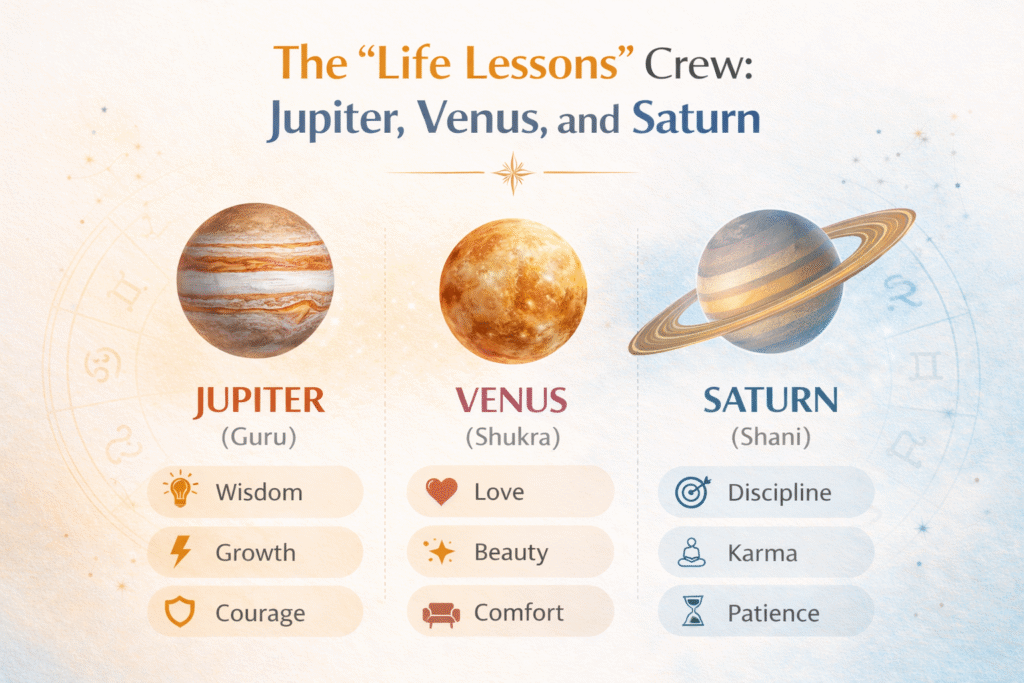
Then, there’s Saturn (Shani). Most people are terrified of Saturn, but he’s just the cosmic auditor. He’s the “adulting” planet. He brings the delays, the “try agains,” and the cold, hard truths. Saturn doesn’t care about your feelings; he cares about your character. He’s the reason you eventually get your act together. If you put in the work, Saturn’s rewards are the only ones that actually stick.
Saturn represents discipline, responsibility, and long-term effort. Its influence is often associated with delays, challenges, and lessons that require patience.
Yet many astrologers eventually notice something interesting about Saturn — the rewards it gives may take time, but they tend to last much longer than the quick gains promised by other planets.
The Wildcards: Rahu and Ketu
These two aren’t even physical planets—they’re shadow points, but they hit hard.
Rahu is your obsession. It’s that “more, more, more” feeling. It’s the hunger for fame, technology, and everything foreign or “new.” It’s a rebel energy that wants to break the rules.
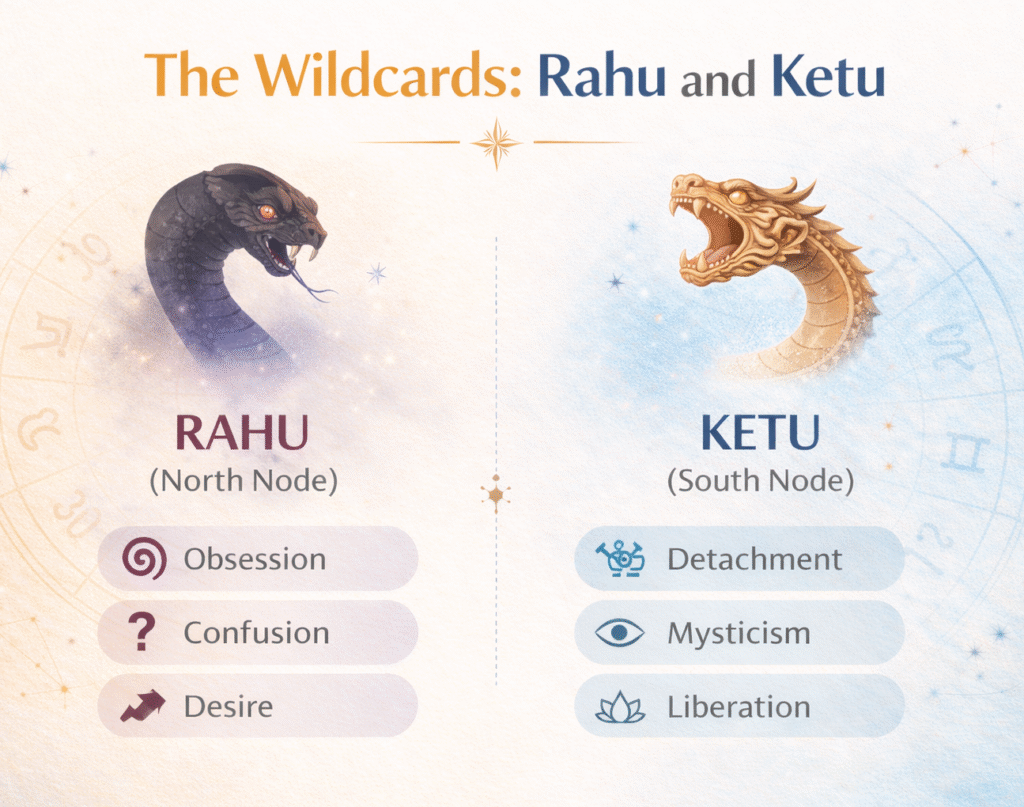
Ketu, his shadow half, is the exact opposite. It’s the feeling of “I’m over it.” Ketu is about detachment, spirituality, and letting go of the material world. It’s that weirdly deep part of you that knows all the “stuff” in life doesn’t actually matter in the end.
So, who’s in charge right now?
But here is something beginners often wonder:
If all nine planets influence the chart, which one is actually shaping your life right now?
You aren’t being hit by all these energies at once (thankfully). In the Vedic system, we go through Mahadashas—basically long “seasons” where one planet takes the lead. You might be in a 20-year Venus cycle where life is all about relationships, only to hit a Saturn cycle where suddenly everything becomes about career and discipline.
In Vedic astrology, these planetary cycles are known as Mahadashas, which indicate the dominant planetary influence during different phases of life.
Read more: How Planetary Dashas Influence Your Life
It’s a Team Effort: How the Planets Interact
The thing is, no planet is an island. You can’t just look at a “strong Mars” and decide someone is going to be a world-class athlete. It doesn’t work like that. Astrology is really about the conversation between these players.We look at things like conjunctions (when two planets are literally sharing a seat) or aspects (how they “look” at each other from across the chart). Think of it like a dinner party: some guests bring out the best in each other, while others just sit in the corner and glare. When an astrologer looks at your chart, they aren’t just reading a list; they’re trying to figure out the “vibe” of the room. This is also where those Dashas (life cycles) come in—they tell us which planet is currently holding the microphone and leading the discussion.
What to Do When the Energy is Off (The Remedies)
So, what happens if a planet is “acting up”? Maybe your Mercury is struggling and you can’t seem to communicate without a misunderstanding, or Saturn is making you feel like you’re walking through mud.
In the Vedic tradition, we don’t just say “well, tough luck.” We use remedies (Upayas) to smooth things over. Think of these as a way to tune your internal radio to a clearer frequency.
- Mantras: Using sound to shift your headspace.
- Charity: Giving back to balance out a “selfish” planetary energy.
- Fasting or Rituals: Building discipline to satisfy a demanding planet like Saturn.
- Gemstones: Using the physical properties of stones to amplify a planet’s better qualities.
The goal isn’t to “cheat” your destiny—it’s about harmonizing with the energy you’ve been given so you aren’t constantly fighting an uphill battle.
The Big Picture
At the end of the day, the Navagraha—these nine celestial influencers—are just a framework for understanding yourself. Your birth chart isn’t a prison sentence or a rigid script of exactly what’s going to happen on Tuesday at 4:00 PM.Instead, think of it as a weather report for your soul. It tells you when it’s going to rain so you can bring an umbrella, and it tells you when the sun is going to shine so you can get outside and make a move. It’s a symbolic language that helps you spot your own blind spots, lean into your natural talents, and navigate life with a little more grace and a lot less confusion.